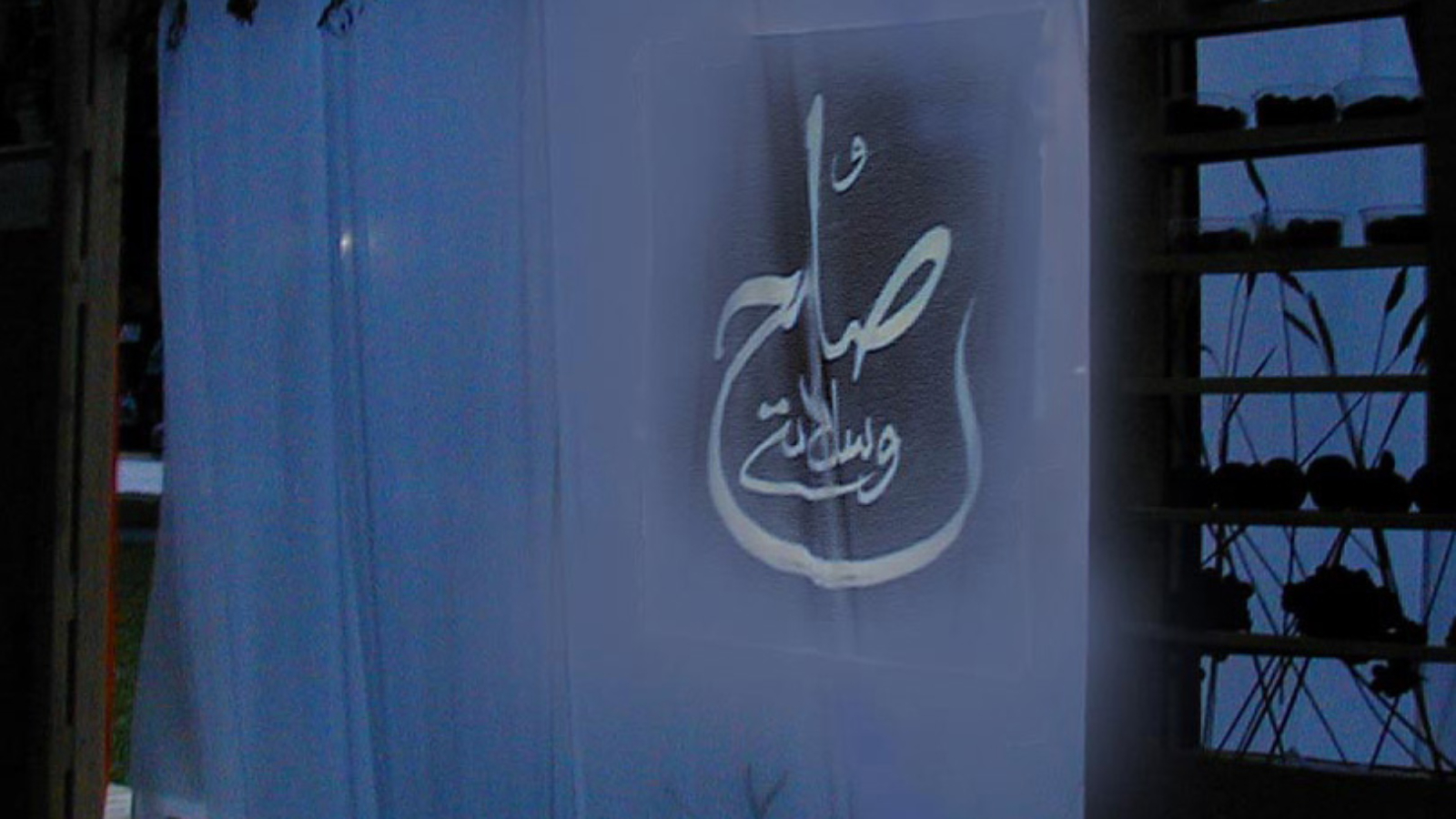
PEACE projected onto the curtains of a Sukkah.– صلح و سلامتي

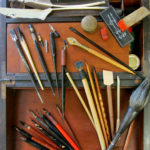
My writing tools, including quills, reed pens (qalam ney), Chinese brushes, sign painting brush and assorted metal nibs (broad nib, copperplate, quill, wire brush, etc.). These are a sampling of the well-used tools of my daily life as a calligrapher. They are displayed on an antique writing desk from India from the time of the British Raj, which features multiple compartments and closes up as a convenient–if somewhat heavy by modern standards–box (purchased from a high up shelf in Doma’s old shop in Mussoorie, India, way back in 1978).
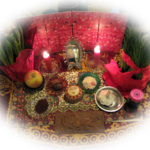
Happy First Day of Spring – No Ruz – Iranian New Year – Vernal Equinox. May the coming year be one of happiness and fulfillment for everyone.
نو روز پيروز
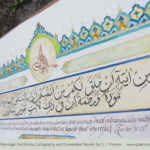
Islamic Marriage Certificate with bismallah, Qur’an inscription in Arabic and English and hand painted illuminated border design. Original work by artist calligrapher Stewart J. Thomas. www.palmstone.com
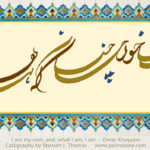
The 11th century poet, Omar Khayyam, says “I am my own, and, what I am, I am / من زان خودم چنان که هستم هستم” Calligraphy and hand painted border by Stewart J. Thomas, www.palmstone.com
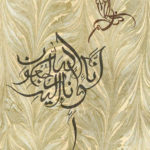
Arabic inscription in the form of a hummingbird and a flower. The hummingbird reads as the bismallah “ ” while the flower reads as “Ina lilah wa ina ilahi rajioon” – “إِنَّا لِلّهِ وَإِنَّـا إِلَيْهِ رَاجِعونَ”
Calligraphy by S. J. Thomas, www.palmstone.com
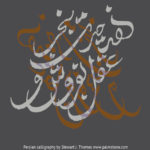
This line of poetry from Rumi has been translated as “Sell your cleverness and buy bewilderment.” I prefer “Sell your cleverness and buy be-wonderment.” The Persian says: buy the art of wonder. Calligraphy by Stewart J. Thomas, www.palmstone.com
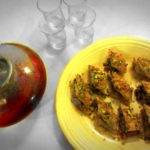
No Ruz Pirooz. Home-made Iranian style baqlava (baklava) made with almonds, pistachios, cardamom and rose water – served with tea, of course. Happy New Year, and may it be a good one.
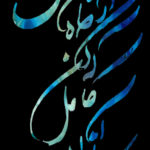
“Dance when you are perfectly free” Persian (Farsi) calligraphy by S.J. Thomas. No Ruz Pirooz!

Ayat al-Kursi (āyatu-l-kursī), the 255th verse (ayah) of the second chapter (sura) of the Qur’an, Al-Baqara. To listen to a recitation of this Ayat, along with translation into English, view here. For a description of the symmetry of the language in this verse read here.
آية الكرسي، وهي الآية رقم 255 من سورة البقرة في القرآن الكريم،.

Persian names in calligraphy by Stewart J. Thomas, calligrapher. www.palmstone.com

From time to time I like to feature a wonderful work from the masters:
Saki, album miniature, 1609
Reza Abbasi, 1565-1635
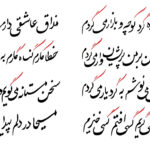
A poem of Mawlana Rumi, “Nah man beehodeh gerde koocheh.” If you would like to hear this song sung in the Sufi ecstatic style, here is a link to a rendering by Nusrat Fateh Ali Khan. The accent is definitely that of Pakistani Urdu, but the singing is all in the original Persian (Farsi), the language of all of Rumi’s poems.
The traslation/transliteration below is not mine, and includes the last two lines of the section, which are not included in the calligraphy version shown here.
Calligraphy by Stewart J. Thomas, www.palmstone.com
Naman behuda girde koocha o bazaar mi gardam,
Neither foolishly nor frivolously, in the lane and the market, I roam
Mazak-e-ashqui daram pa e didar mi gardam,
Possessed by the temperament of the lover I am, to have a glimpse, I roam
Khudaya reham kun bar mann pareeshaan waar mi gardam
O, God, the Almighty! Shower Your mercy upon me, disturbed and distracted, I roam
Khataa kaaram gunah gaaram bahaal e zaar mi gardam,
I am guilty, I am sinful and in this wretched condition, I roam
Sharaab-e-shouq mi nousham bagird e yaar mi gardam,
The wine of fondness I drink and round the Friend, I roam
Sukhan mastana mi goyam bhale hushyaar mi gardam,
Like the intoxicated I talk, but like the wise, I roam
Gahe khandam gahe giriyam gahe uftam gahe khezam,
Sometimes I laugh, sometimes I weep, sometimes I fall, sometimes I rise
Maseeha dar dilam paida ho mann beemaar mi gardam,
The Messiah is within my heart and like an invalid, I roam
Bayaan jaanan inayat kun to molana-e-rumi ra,
Come, O My Beloved! Come! Help your Maulana Rum
iGhulam-e-shams tabrezam qalandar war mi gardam
I am a slave of Shams Tabrizi and like a qalandar, I roam
(Translation from http://kalam-e-rumi.blogspot.com/)
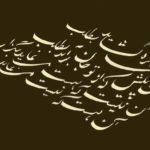
From Rumi:
Seek the science that unties for you this knot.
Seek it as long as there’s life in you still to be sought.
Leave that nothing that looks like it is something;
Seek that something that looks like nothing; it is not.
Translation by Zara Houshmand
Calligraphy by Stewart J. Thomas, palmstone.com
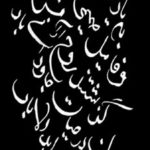
Persian calligraphy created as a tattoo design for a client. www.palmstone.com

Wedding Monogram created by Stewart J. Thomas combines two names inside of a floral teardrop. www.palmstone.com
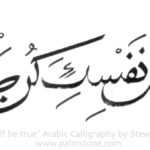
“To thine self be true” Arabic calligraphy by S. J. Thomas, www.palmstone.com
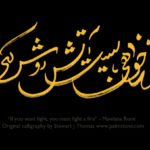
“if you want light, you must light a fire” Persian poetry by Jalaluddin Maulana Rumi. Persian (Farsi) calligraphy by Stewart J. Thomas www.palmstone.com.
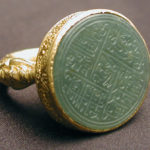
Seal ring with inscription
Iran or Central Asia, late 15th-early 16th century
This magnificent gold ring holds a jade stone engraved with religious verses known as the Nad-i ‘Ali, an invocation to ‘Ali ibn Abi Talib, son-in-law of the Prophet Muhammad. The text is written in mirror reverse, suggesting that the stone may once have served as a seal. Further tiny poetic inscriptions—in cartouches around the golden bezel—contain prayerlike verses, perhaps invested with apotropaic qualities, placed there to ensure the safety of its wearer.
Inscription: Inscriptions in Arabic in thuluth script on stone: At center of seal:عزمن لا یموتGlorified be [He] who will not die. Surrounding seal, in four segments:ناد علیاً مظهر العجائبی تجده عوناً لك في النوائبي کل هم و غم سینجلي بولایتك یا علي یا علي یا عليCall upon ‘Ali, the revealer of miracles made manifest, You will find him a comfort to you in times of misfortune All care and sorrows will disappear through your companionship, O ‘Ali, O ‘Ali, O ‘Ali Inscription in Persian in thuluth script, around bezel:جانـا نـداي تـرا بجاهسـت کـه حدیـث گویـم عالم هر دو در نگین جانبخش لعل شماست سلیمان خوان ازین خاتم عالم بود در کفش کــه مهـــر جانـــم هســـت محبـــت سانــم؟O my Lord! Instead of writing Thy name, I say the following words. O my soul! In consequence of my love Thy image is everywhere with me. O my soul! Be as wise in conversation as Solomon. My world and heaven are in this ring.”Inscription in Persian in kufic script on interior of bezel:مبارک بادBe fortunate Inscription in kufic script underneath stone:محمدMuhammad
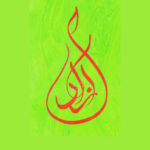
Freedom “Azadi” Persian calligraphy design by Stewart J. Thomas, www.palmstone.com
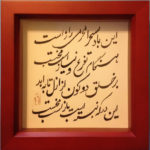
Poetry by Jalaluddin Rumi, calligraphy by Stewart J. Thomas, palmstone.com. A popular translation of this passage reads:
“The breezes at dawn have secrets to tell you.
Don’t go back to sleep!
You must ask for what you really want.
Don’t go back to sleep!
you really want.
People are going back and forth across the door sill where the two worlds touch.
The door is round and open.
Don’t go back to sleep!”
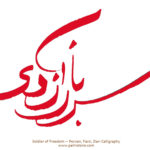
Sarbaz-e Azadi “Soldier of Freedom” designed as a Farsi (Persian) tattoo for a client, by S. J. Thomas. www.palmstone.com


