Bird Calligraphy in Arabic Script. Calligraphy design by Stewart J. Thomas www.palmstone.com
Bird Calligraphy in Arabic Script. Calligraphy design by Stewart J. Thomas www.palmstone.com

Islamic Marriage Certificate with original border design in watercolour and gouache; Bismallah in black, copper and gold ink; and calligraphy in Arabic and English. The top section is in Arabic from the Qu’ran, with an English gloss of the text below it in Italic calligraphy. Original artwork and calligraphy by Stewart J. Thomas. www.palmstone.com
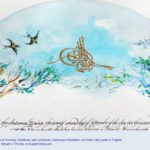
Detail of the headpiece of a marriage certificate produced in September 2013. This commission includes geometric Islamic borders, birds and the watercolour headpiece shown here. More details to be posted soon. The Bismallah is in raised gold and the body of the certificate in italic calligraphy in English. Original work by artist and calligrapher Stewart J. Thomas. www.palmstone.com
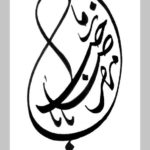
This was commissioned by a follower of Meher Baba. Calligraphy by Stewart J. Thomas, www.palmstone.com

A very loose rendering of contemporary Kufic style calligraphy. This is a Persian phrase that could be rendered into English as “In this world, not of this world.” Calligraphy by Stewart J. Thomas. Commissions accepted at www.Palmstone.com


Earlier I posted the draft design for this commission. This is a photograph of the completed painting featuring the last lines of Khalil Gibran’s poem on marriage. Original calligraphic painting in Arabic by calligrapher Stewart J. Thomas.

A great selection of Persian fonts and handwritten calligraphy in different sign formats. Great photograph, too. I love reflections and how they show the layering of what’s taking place in life. The intimacy of three people at a sandwich shop vs. the bustle of traffic outside is nicely juxtaposed in this photo.

(Pages on astronomy from the Timbuktu Manuscripts).
Libraries of Timbuktu
“At the height of the city’s golden age, Timbuktu boasted not only the impressive libraries of Sankore and the other mosques, but also a wealth of private ones. One of the greatest, containing more than 700 volumes, was left by the master scholar Hajji Ahmad bin ‘Umar. His library was said to have included many of the rarest books ever written in Arabic, and he copied and annotated a considerable number of the volumes himself.
The libraries of Timbuktu grew through a regular process of hand-copying manuscripts. Scholars would visit the caravanserais and appeal to learned travelers to permit their precious volumes to be reproduced. Alternatively, they duplicated texts borrowed from their mentors’ collections, studying the material as they did so.
Al-Wazan commented that “hither are brought divers manuscripts or written books, which are sold for more money than any other merchandise.” As late as the close of the 19th century, Félix Dubois purchased a number of antique books in Timbuktu, including a copy of the Divan of Kings, a chronology of the rulers and events of the Sudan between 1656 and 1747.
Timbuktu’s position as a principal staging point along the pilgrimage route to Makkah may partly explain why so many books were available. Even so, modern scholars are staggered by the sheer quantity and rarity of Arabic texts and poems proffered and composed in the city. Of the books written in Timbuktu, a number are surprising in their scope. Ahmed Baba’s biographical dictionary, for example, included the lives of notables from Arabia, Egypt, Morocco and Central Asia, as well as Timbuktu itself.”
(From The Islamic Legacy of Timbuktu, Saudi Aramco World, Nov/Dec 1995)
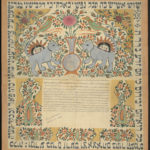
Ketubah from Esfahan, Persia, 1840s, unknown artist
Note the sun figures rising from behind the lions – traditional Iranian theme, and parrots – still associated with Ketubim from Iran to Spain.
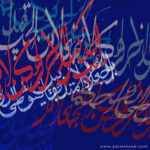
This is a draft of a design I created for a commissioned calligraphic painting of the last line of Khalil Gibran’s poem on marriage. For the actual painting I used a different layout of the calligraphy, which I will post at a later date. Original Arabic calligraphy by Stewart J. Thomas.
ليُحِبَّ أحدُكما الآخر، ولكن لا تجعلا من الحبِّ قيداً
بل اجعلاه بحراً مُتَدَفِّقاً بين شواطئ أرواحكما
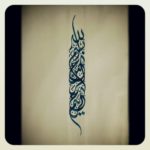
I really like this unusual presentation of the Bismallah: In the name of God, the compassionate, the merciful.
Vertical Basmallah Calligraphy
بسم الله الرحمن الرحيمIn the Name of Allah, Most Gracious, Most Merciful.Originally found on: 3mag
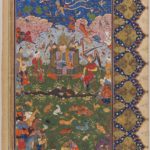
Solomon Enthroned with Angels, Beasts, and Demons Folio from a Safavid manuscript, 1575–90
Unknown Artist, Shiraz, Iran.
Harvard Art Museums/Arthur M. Sackler Museum, The Norma Jean Calderwood Collection of Islamic Art.“This folio is half of what was a double-page frontispiece depicting King Solomon on the right and Bilqis, the Queen of Sheba, on the left. The Calderwood painting represents Solomon and his court, including his vizier Asaf, surrounded by animals, birds, angels, and divs. This scene is not linked to the text of the Shahnama per se, but rather reflects concepts of the ideal ruler. Similar depictions of Solomon appear as frontispieces in many Safavid illustrated manuscripts, merging the image of the just king with that of a prophet who is close to God.The rich detail, bright colors, and lively composition of this frontispiece would have made it visually suitable for introducing the kingly adventures narrated and depicted in the following pages of the manuscript. The painting is surrounded by a wide band of illumination, in blue and gold with delicate floral tracery.”(via Harvard Art Museums)
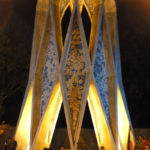
The tomb of Persian poet Omar Khayyam, in Iran. This modern structure is a phenomenal piece of design, incorporating ancient architectural forms, open spaces for light, a continuing line which wraps the entire structure, and the panels of calligraphy which are, of course, lines from Khayyam’s Rubaiyat and other poems. The tombs of the poets are major cultural destinations for Iranians and performances of poetry and music are held regularly, as the one shown here.
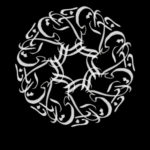
Calligraphic rondel by Stewart J. Thomas designed as a tattoo incorporating the names Ariana and Ellahi.
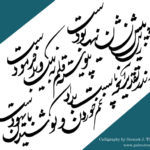
Lines of poetry from the Rubaiyat by Persian poet Omar Khayyam. Original calligraphy by Stewart J. Thomas.

MAIMONIDES, MISHNEH TORAH, AUTOGRAPH DRAFT
This is a draft of a portion of the Book of Civil Laws, a section of the “Mishneh Torah” of Maimonides (1135– 1204), written in his own hand. The philosopher and royal physician wrote his masterpiece on rabbinic law in Hebrew, whereas his earlier works had been composed in Judeo-Arabic (Arabic in Hebrew characters). Maimonides’s cursive Sephardic script is similar to contemporary Arabic script. The pages seen here deal with the laws of hiring (right) and the laws of borrowed and deposited things (left).
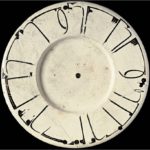
Ceramic plate from Nishapur, Iran, 10th century C.E. The border in Kufic style Arabic script can be translated as “Knowledge: the beginning of it is bitter to taste, but the end is sweeter than honey.”
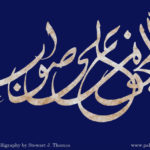
“The stars are right” by H.P. Lovecraft. Calligraphy created for annual conference by Stewart J. Thomas, palmstone.com
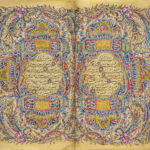
A beautiful double page spread from a calligraphed edition of the Quran. This is unusual in that the calligraphy is in the Persian nastaliq style and the decorations are free-flowing floral patterns. If anyone knows the provenance of this piece, let me know. Otherwise I am doing my own investigations. For my own work, see palmstone.com