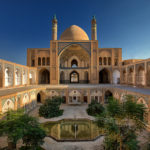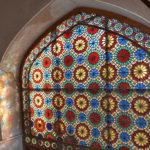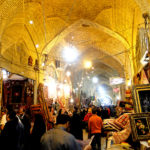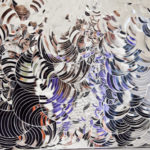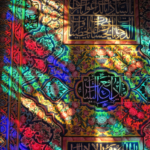
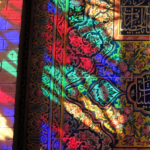
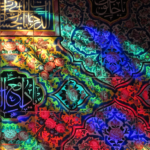
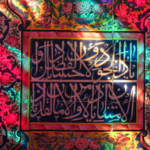
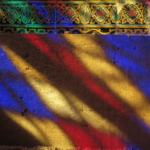
Masjed Nasir-al-Molk, Shiraz, Iran. The great strength of Iranian architecture is the use of light!
Masjed Nasir-al-Molk, Shiraz, Iran. The great strength of Iranian architecture is the use of light!
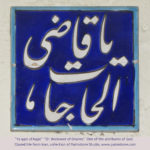
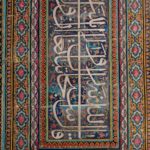
یا قاضی الحاجات
Ya Qazi ul Hajat, or Ya Qadhi al Hajat is recited as one of the attributes of God (Allah) is usually translated into English as “Oh, Bestower of Desires.” More literally translated it might be rendered as “Oh, Judge of [our] needs.” To me the latter conveys an important attribute, that God does not just grant our wants, but knows what it is we truly need. This cobalt-blue glazed tile from Iran dates from the 1970s. In the collection of Stewart J. Thomas, www.palmstone.com
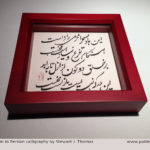
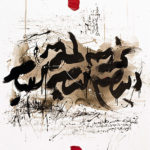
Calligraphy by Stewart J. Thomas of the poem by Rumi, translated as:
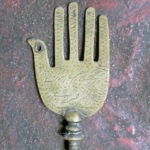
Brass hand in the form of a bird. Middle eastern folk art in the collection of Palmstone Studio.
Between what is said and not meant And what is meant and not said Most of love is lost
Desert Landscapes of Iran: George Steinmetz
http://5centsapound.tumblr.com/post/51677484401/desert-landscapes-of-iran-george-steinmetz-1
1 & 2. Aerial views of Salt Domes of the Dasht-e Kavir.
3 & 4. Strong dry winds have dried the surface of this salt river into a web of hair-like salt crystals. Their orientation preserves a record of the wind as it blew across the surface.
5. Abandoned old city of Torud borders on fields that are still cultivated from water that is supplied by a subterranean aquifer via ancient qanats.
6. Mega-dunes of the Dasht-e Lut. These are the largest and tallest dune field in Iran, reaching over 300M in height and covering an area approx. 50 X 150 Km
7 & 8. Yardang field of the Dasht-e Lut. This is the largest field of wind-eroded rocks (yardangs) in the world, measuring some 50 x 100 Km
9 & 10. Otherworldly landscape of the Makran Coast; along the shore of the Indian Ocean; between Chabahar and the Pakistani frontier. The hills were made of gypsum-rich mud which is is brick hard when baked by the sun, but easily eroded into Karst-like forms when drenched by monsoon rains.

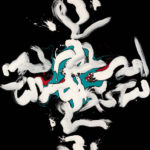
“Heech” literally meaning “nothing” in Persian can also be understood as the void, the space to be filled by creation and creativity. This work is in homage to Parviz Tanavoli. His work, which II saw regularly growing up in Tehran has been an enormous inspiration in my own artwork and understanding of calligraphy.
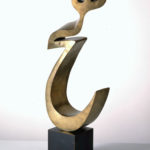
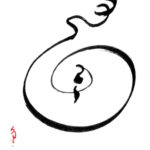
The work of Tanavoli has been enormously influential on my artwork and viewpoint, and a version of this sculptural work perhaps more than any other single work has informed my own understanding of calligraphy. I show here Tanavoli’s sculpture of “Heech” and my own humble homage to his work.
Many of his works are in the collection of the Grey Art Gallery at NYU. Their website says of this work:
In his sculpture entitled Heech, Tanavoli translates Persian calligraphy into three-dimensional form. Although the Persian word heech means “nothing,” the work is not meant to express despair or emptiness. Instead, for Tanavoli, the heech might represent creativity itself the void filled by the artist’s imagination.1 Tanavoli was a close friend and advisor to Abby Grey, who avidly collected his work. Her generous gift of modern Asian and Middle Eastern art works, along with an endowment, to New York University led to the founding of the Grey Art Gallery, which first opened its doors in 1975.
1. Paul Sloman, ed., Contemporary Art in the Middle East (London: Black Dog Publishing, 2009), 88.
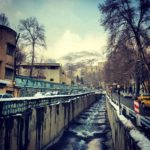
This view of the northern reaches of Tehran, Iran is notable for showing a type of Iranian waterway. The steps prevent the water from rushing down the sloped waterway with too much force. Note the depth: when snow melt becomes heavy the waterway fills up rapidly.
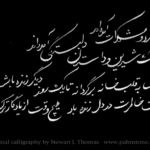

“A composition from the 18th or 19th century India and now in a Riyadh collection, heavily stylized Kufic lettering is formed into a shape like a Mihrab or prayer niche. The four central panels contain part of Sura Al-Qalam (The Pen) of the Qur’an.”
– Source
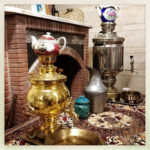
Tea Samovar. The one in the foreground is very similar to a beautiful samovar that used to be in our family.
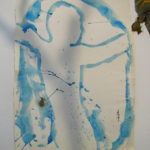
Part of the art installation “Walking in the Garden” by artist Stewart J. Thomas.
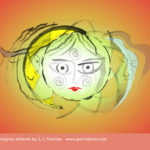
In Iran the sun is Khorshid Khanoum, “Lady Sun” – original artwork in ink and watercolour by Stewart J. Thomas.