Cedar of Lebanon Tattoo

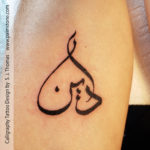
Cedar of Lebanon Arabic Tattoo


Cedar of Lebanon Tattoo

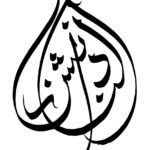
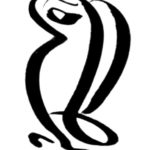
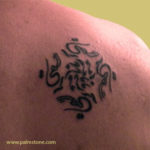
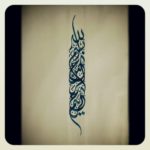
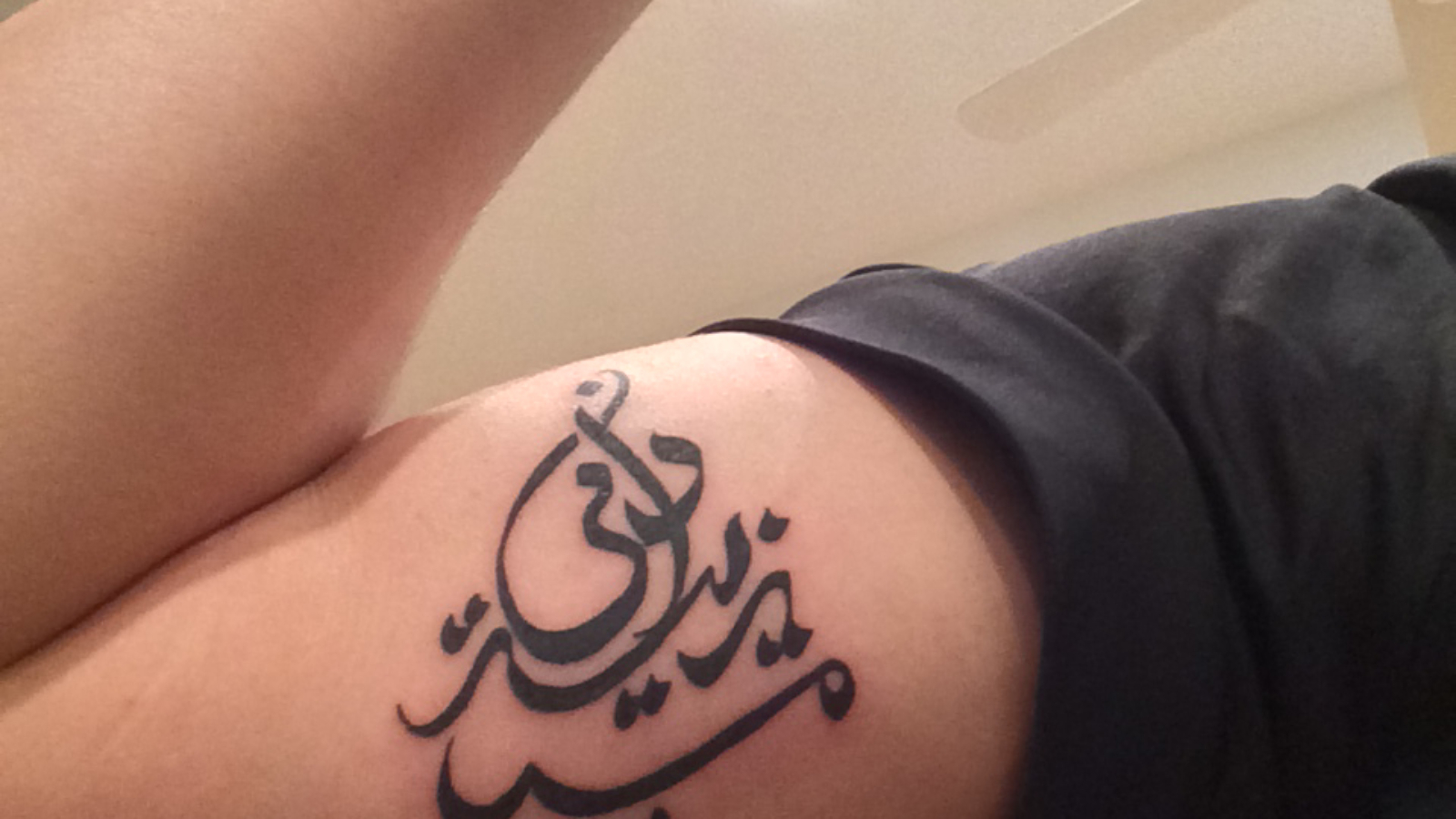
My client requested an Arabic tattoo in the shape of the famed Cedar of Lebanon, shown here very nicely inked onto the arm. After I provide you with a custom designed calligraphy tattoo it is very gratifying to see the work inked by a skilled professional tattoo artist. The sharp edges, changing pen widths and fine lines need to be done properly to bring out the true beauty of the Arabic calligraphy. While this is technically not a “zoomorphic” design — it is in the shape of something living!

Rumi_fire_palmstone.com_

Persian, Urdu, Arabic and Farsi Calligraphy

ORDER YOUR CALLIGRAPHY DESIGN

I bring over 40 years of experience as a calligrapher to my work in Farsi, Persian, Urdu and Arabic Calligraphy. I work in both contemporary and traditional calligraphy styles, providing work for a diverse array of clients worldwide. For calligraphy in other languages and scripts, please visit my website palmstone.com. For inquiries and orders, please submit a contact form. 

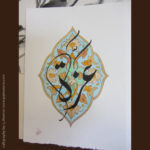
I provide calligraphy for names and monograms, wedding monograms, illuminated marriage certificates, architectural calligraphy, tattoo designs, book cover and publication design, logos, signage, and many other types of projects. I also create calligrams (calligraphy in a specific shape) and zoomorphic designs (calligraphy in the shape of animals).

Persian, Urdu, Arabic, Dari and Farsi Calligraphy

My procedure is to first learn as much as I can about the project you have in mind. In order to create a calligraphic design I typically produce a number of versions for the client to review. In addition to calligraphy commissions I also produce original art for sale. I am available for calligraphy workshops, seminars and presentations as my schedule permits.

I receive quite a number of requests regarding Rumi, Hafiz and other Persian poets. Happily many people have come to appreciate Persian poetry due to the popularity of recent versions of the work in English. Tracking down the original Persian counterparts of these translations can be tricky. Rumi was a prolific poet, whose complete works run to many volumes. The versions in English are often not exact translations. I take up researching the original lines of poetry on behalf of my clients and do my best to offer a deeper understanding of the original wording of the passages.

Key Terms: Arabic Calligraphy, Persian Calligraphy, Farsi Calligraphy, Urdu Calligraphy, Calligrapher, Iranian Calligraphy, Iranian Fine Art.

Persian Calligraphy | Farsi Calligraphy | Arabic Calligraphy | Urdu Calligraphy | Dari Calligraphy |
خطوط العربية | خوش خط فارسى | خطاط
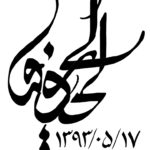
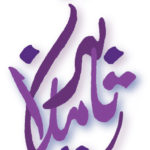
Qadim Monogram

Names and Monograms

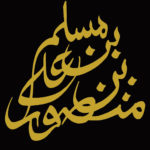
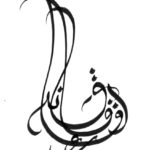
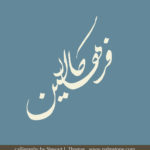
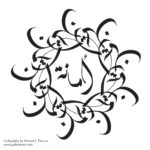
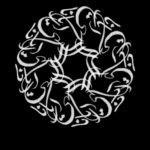
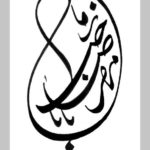
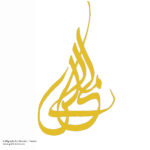
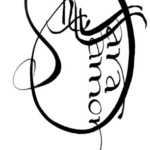
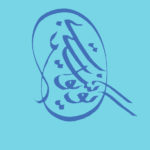
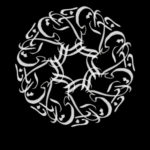
If you want a unique calligraphic design of one or more names, you have come to right place. Simple or complex, free form or in a particular shape, mirror-style, kufic, buteh or teardrop, calligrams in the shape of an animal (zoomorphic) or plant or something else, all these designs–and many more–are possible. The gallery below represents only a small sampling of the hundreds of monograms I have created for individuals, couples and families. Monograms are very popular for weddings (invites, wax seals, embossing, wedding cakes, favors, etc.). I often design monograms to be included on wedding certificates. Monograms are also popular as family crests or logos, and individual insignia, and used for tattoos and jewelry, printed on clothing, and used as signature devices on emails.

أهلاً وسهلاً

Ahlan Wa Sahlan: أهلاً
وسهلاً

Arabic,
Stylized Kufic Script

Traditional
Arabic welcome–especially to a home– emphasizing hospitality to
strangers.
Ahlan—أهلا–
is
“family,” as in “You’ve come to stay with family,”
and sahlanسهلا
is
flat or open place without obstacles and where there is abundance to
be shared with visitors. “Welcome:
you’re with family, be at ease.” The calligraphy is done in a stylized Kufic that brings to mind traditional Palestinian embroidery designs. Calligraphy available as a limited edition, hand colored print, with 50% of proceeds for Syrian Refugee Relief. Visit www.palmstone.com/for-syria/ to view art and purchase.

Bismallah

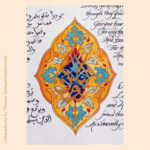
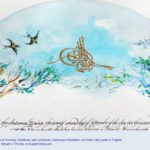
Detail of the headpiece of a marriage certificate produced in September 2013.  This commission includes geometric Islamic borders, birds and the watercolour headpiece shown here.  More details to be posted soon.  The Bismallah is in raised gold and the body of the certificate in italic calligraphy in English.  Original work by artist and calligrapher Stewart J. Thomas. www.palmstone.com

Libraries of Timbuktu

purplefigtree:

(Pages on astronomy from the Timbuktu Manuscripts).

Libraries of Timbuktu

“At the height of the city’s golden age, Timbuktu boasted not only the impressive libraries of Sankore and the other mosques, but also a wealth of private ones. One of the greatest, containing more than 700 volumes, was left by the master scholar Hajji Ahmad bin ‘Umar. His library was said to have included many of the rarest books ever written in Arabic, and he copied and annotated a considerable number of the volumes himself.

The libraries of Timbuktu grew through a regular process of hand-copying manuscripts. Scholars would visit the caravanserais and appeal to learned travelers to permit their precious volumes to be reproduced. Alternatively, they duplicated texts borrowed from their mentors’ collections, studying the material as they did so.

Al-Wazan commented that “hither are brought divers manuscripts or written books, which are sold for more money than any other merchandise.” As late as the close of the 19th century, Félix Dubois purchased a number of antique books in Timbuktu, including a copy of the Divan of Kings, a chronology of the rulers and events of the Sudan between 1656 and 1747.

Timbuktu’s position as a principal staging point along the pilgrimage route to Makkah may partly explain why so many books were available. Even so, modern scholars are staggered by the sheer quantity and rarity of Arabic texts and poems proffered and composed in the city. Of the books written in Timbuktu, a number are surprising in their scope. Ahmed Baba’s biographical dictionary, for example, included the lives of notables from Arabia, Egypt, Morocco and Central Asia, as well as Timbuktu itself.”

(From The Islamic Legacy of Timbuktu, Saudi Aramco World, Nov/Dec 1995)

Khalil Gibran on Marriage

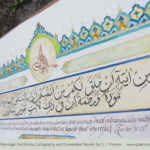
This is a draft of a design I created for a commissioned calligraphic painting of the last line of Khalil Gibran’s poem on marriage.  For the actual painting I used a different layout of the calligraphy, which I will post at a later date.  Original Arabic calligraphy by Stewart J. Thomas.

ليُحِبَّ أحدُكما الآخر، ولكن لا تجعلا من الحبِّ قيداً
بل اجعلاه بحراً مُتَدَفِّقاً بين شواطئ أرواحكما

MAIMONIDES, MISHNEH TORAH, AUTOGRAPH DRAFT

MAIMONIDES, MISHNEH TORAH, AUTOGRAPH DRAFT

Egypt, c. 1180, found in the Cairo Genizah.

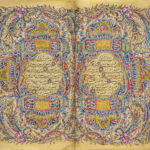
This is a draft of a portion of the Book of Civil Laws, a section of the “Mishneh Torah” of Maimonides (1135– 1204), written in his own hand. The philosopher and royal physician wrote his masterpiece on rabbinic law in Hebrew, whereas his earlier works had been composed in Judeo-Arabic (Arabic in Hebrew characters). Maimonides’s cursive Sephardic script is similar to contemporary Arabic script. The pages seen here deal with the laws of hiring (right) and the laws of borrowed and deposited things (left).

Previous poster observed: I don’t detect any similarity between Maimonides’ Sephardic script and Arabic script, except that they’re both oriented right to left.
Stewart Thomas, calligrapher, says: This is a fascinating calligraphic hand, with clearly visible Hebrew characters combined with sections in a type of cursive. To me the cursive sections look very similar to contemporary Arabic script. Originally Hebrew and Arabic were both written with individually separated letters (and with short vowels unwritten). While Arabic evolved into its contemporary cursive form, Hebrew did not. This is a wonderful sampling of the beginnings of a Hebrew cursive form.

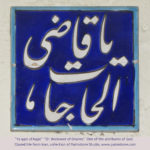
Ya Qazi ul Hajat, or Ya Qadhi al Hajat Tile


یا قاضی الحاجات

Ya Qazi ul Hajat, or Ya Qadhi al Hajat is recited as one of the attributes of God (Allah) is usually translated into English as “Oh, Bestower of Desires.” More literally translated it might be rendered as “Oh, Judge of [our] needs.” To me the latter conveys an important attribute, that God does not just grant our wants, but knows what it is we truly need. This cobalt-blue glazed tile from Iran dates from the 1970s. In the collection of Stewart J. Thomas, www.palmstone.com