I bring over 40 years of experience as a calligrapher to my work in Farsi, Persian, Urdu and Arabic Calligraphy. I work in both contemporary and traditional calligraphy styles, providing work for a diverse array of clients worldwide. For calligraphy in other languages and scripts, please visit my website palmstone.com. For inquiries and orders, please submit a contact form.
My procedure is to first learn as much as I can about the project you have in mind. In order to create a calligraphic design I typically produce a number of versions for the client to review. In addition to calligraphy commissions I also produce original art for sale. I am available for calligraphy workshops, seminars and presentations as my schedule permits.
I receive quite a number of requests regarding Rumi, Hafiz and other Persian poets. Happily many people have come to appreciate Persian poetry due to the popularity of recent versions of the work in English. Tracking down the original Persian counterparts of these translations can be tricky. Rumi was a prolific poet, whose complete works run to many volumes. The versions in English are often not exact translations. I take up researching the original lines of poetry on behalf of my clients and do my best to offer a deeper understanding of the original wording of the passages.
Key Terms: Arabic Calligraphy, Persian Calligraphy, Farsi Calligraphy, Urdu Calligraphy, Calligrapher, Iranian Calligraphy, Iranian Fine Art.
Persian Calligraphy | Farsi Calligraphy | Arabic Calligraphy | Urdu Calligraphy | Dari Calligraphy |
خطوط العربية | خوش خط فارسى | خطاط
For poetry in Persian / Farsi, calligraphy is the natural partner. I receive many requests to calligraph the works of both classical and contemporary Persian poets and to produce calligraphic art for framing, weddings, book publication, tattoos and even jewelry. In addition I often have to help research the original Persian / Farsi source of poetry that may be available to you only in English or in partially remembered form handed down orally in your family. To read more about some of the great poets please scroll down below the image gallery.
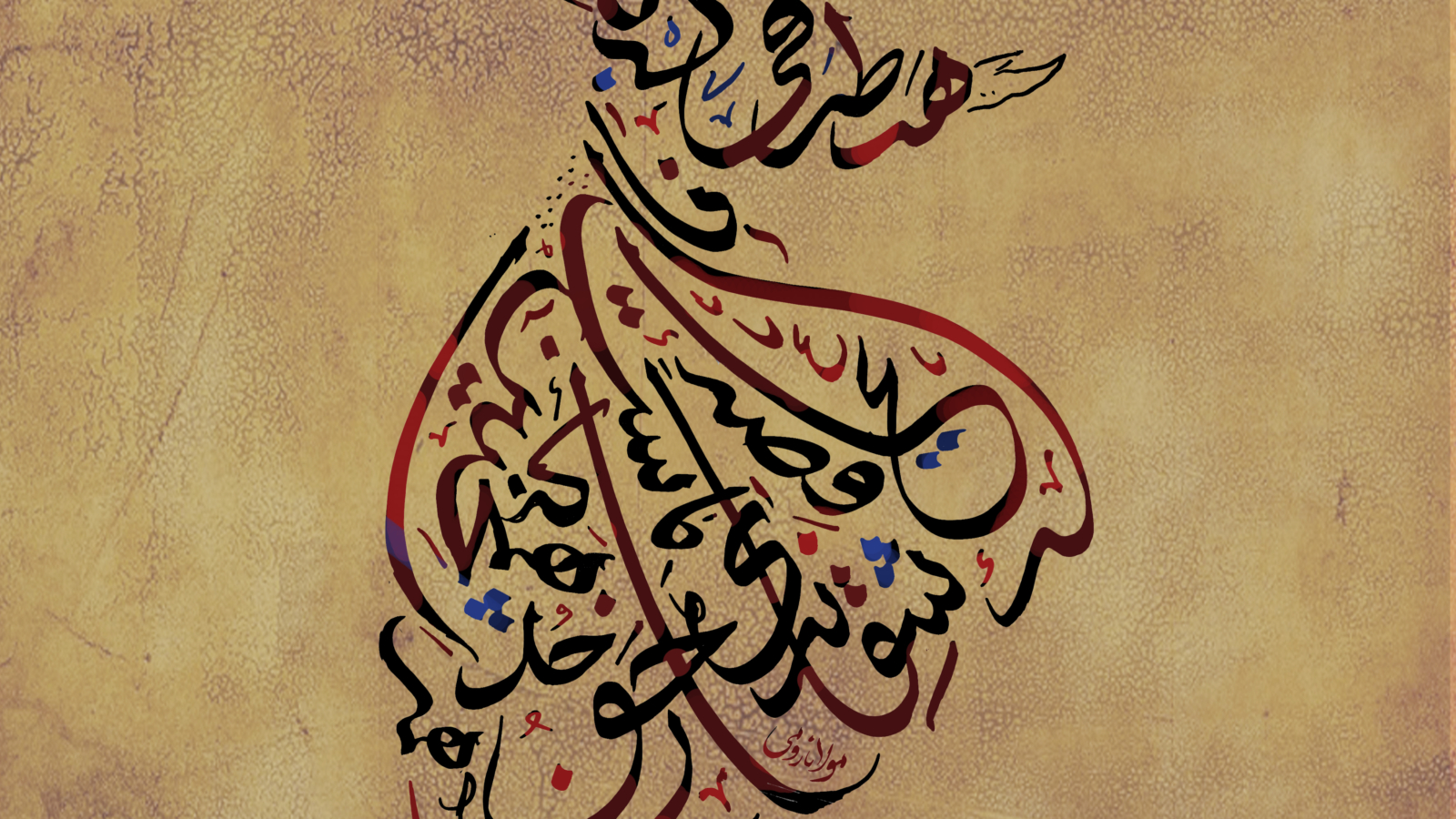
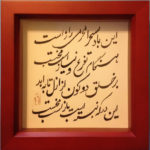
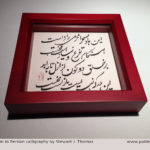
As an example of poetry in Persian / Farsi calligraphy, I recently completed this original hand painted design featuring Rumi’s poetry in Persian and in translation. Artwork framed to 14 x 18 inches (35 x 45 cm). Scroll down to see more calligraphy treatments of poetry in Persian, Arabic and Urdu.
Rumi, Breezes at Dawn
Fire in the Rain
Khalil Gibran Painting
Gibran vertical lines
Ibn Arabi Rondel
Rumi
Alchemy
Don’t know the end of me and the beginning of thee
Rumi: Sell your cleverness
Iqbal
Darwish
Rumi Breezes at Dawn
Dance when you are perfectly free
Rumi Fire
Rumi Story of Love
Rumi Tattoo
Sell your cleverness
This too shall pass
Be Expansive
Rumi Dervish
Sa’adi
This too shall pass Phoenix
Ghalib poetry in Urdu
Hafez
Poetry in Persian / Farsi Calligraphy
The poetic tradition is one of the prime sources for the Persian calligraphic arts. There are scores of famous poets in the classical tradition as well as many more that are deserving of greater fame. The world of contemporary literature also features many wonderful poets.
I will update this list over time, but here is a start to familiarize with some of the great poets:
Rumi (Jalāl ad-Dīn Muhammad Rūmī), (1207-1273), often known as Mowlana, مولانا, or Molavi, مولوی, is now one of the most quoted poets in the world. An international figure even in how own day, his works are enjoying a new life throughout the world. Many people come to Rumi through his works in translation. I am often asked to locate the original Persian (Farsi) lines of poetry. This task requires patience because Rumi’s works are voluminous and there is no index or even agreed-upon standard edition. Thankfully I enjoy reading Rumi’s work in the original and I am also in touch with a network of Rumi scholars who are wonderful allies in tracking down the master’s words. #rumi #rumicalligraphy #rumiart #rumipoetry #persiancalligraphy
Kahlil Gibran (جبران خليل جبران) (1883-1931) is another poet known widely in translation. His works gained worldwide fame during his lifetime and have remained popular ever since. Born in Lebanon, Gibran wrote in both Arabic and English. His most popular work, The Prophet, has remained in print since its initial publication in 1923. I have produced many calligraphic pieces featuring Gibran’s work. #gibran #kahlilgibran #theprophet #arabiccalligraphy
Kabir (15th Century) (कबीर) is revered as a poet, mystic and saint in both Muslim and Hindu communities. His work is remarkable for its infusion of many languages brought together in simple, direct and beautiful expression. Many of these have been put to music and are an integral part of the musical tradition of India. Kabir’s works can be written in both Urdu calligraphy, which uses a modified form of the Arabic script, or in Devanagari calligraphy, which is the same alphabet used to write Hindi, Sanskrit and many other North Indian languages. #Indiapoetry #Indianpoetry #Kabir #SantKabir #Hindipoetry
Mahmoud Darwish (1941-2008) (محمود درويش) gave voice to the Palestinians in the latter half of the 20th century, served as editor of a literary magazine in Israel, and received numerous literary and peace prizes. His language is modern, direct, poignant and eloquent. I have produced a number of pieces featuring the poetry of Darwish in contemporary Arabic calligraphy. #Darwish #Mahmoud Darwish #Arabiccalligraphy #Arabicpoetry
Ibn Arabi (1165-1240) is revered as an outstanding scholar, poet and Sufi Saint. He lived in Andalusia (Spain) and produced some 800 works, of which over 100 had survived. I enjoy Ibn Arabi’s poetry for its rich imagery and use of metaphor as he explores the entwined natures of the human and the divine. The earliest successful Arabic calligraphy rondel I created is the text of Ibn Arabi’s famous poem which begins “O Marvel! a garden amidst the flames. My heart has become capable of every form.” #IbnArabi #Arabiccalligraphy #Arabicpoetry #IbnArabipoetry #Arabic #Sufipoetry
Persian Poets: The work of the Persian poets is known and quoted as part of everyday life in a wide swath of South, Central and Western Asia. The Sufi poets are particular favorites of mine. Classical poets include Roudaki, Ferdowsi, Hafiz (Hafez), Sa’adi, Khayyam and Attar of Nishapur. Modern poets whose work I enjoy include Sohrab Sepehri, Forough Farrokhzad. Poetry, music and calligraphy all intersect in Iranian culture as loci for improvisation and the heartfelt expression of love, loss, and personal, political and spiritual longings and aspirations.
The poetic tradition is so rich and vital among Persian poets, Arab poets and Urdu poets. This tradition is carried forth by men and women, singers and musicians, and the millions of people who memorize and use poetry as part of everyday life. As a speaker of Persian, my familiarity is greatest with the Iranian poets, although I enjoy reading poetry in Arabic, Urdu and Hindi, piecing the words and meanings together slowly. And of course I also read poetry in two other languages in which I have some education: English and Chinese.
I welcome all inquiries and commissions for poetry calligraphy. Suggested formats include the rondel, the illuminated manuscript-style page, the Persian format of the Siahmashq (سياه مشق or سيامشق), zoomorphic designs, and contemporary layouts.
This line of poetry from Rumi has been translated as “Sell your cleverness and buy bewilderment.” I prefer “Sell your cleverness and buy be-wonderment.” The Persian says: buy the art of wonder. Calligraphy by Stewart J. Thomas, www.palmstone.com
A poem of Mawlana Rumi, “Nah man beehodeh gerde koocheh.” If you would like to hear this song sung in the Sufi ecstatic style, here is a link to a rendering by Nusrat Fateh Ali Khan. The accent is definitely that of Pakistani Urdu, but the singing is all in the original Persian (Farsi), the language of all of Rumi’s poems.
The traslation/transliteration below is not mine, and includes the last two lines of the section, which are not included in the calligraphy version shown here.
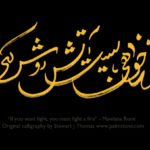
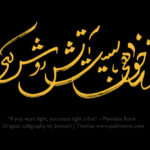
“if you want light, you must light a fire” Persian poetry by Jalaluddin Maulana Rumi. Persian (Farsi) calligraphy by Stewart J. Thomas www.palmstone.com.
Calligraphy by Stewart J. Thomas of the poem by Rumi, translated as:
“The breezes at dawn have secrets to tell you
Don’t go back to sleep!
You must ask for what you really want.
Don’t go back to sleep!
People are going back and forth
across the doorsill where the two worlds touch,
The door is round and open
Don’t go back to sleep!”
Mawlana Rumi wrote these two lines about the lover and the beloved. I am not aware of a translation into English. I shall undertake to translate it myself, but in the meanwhile if someone knows of a translation please let me know in the comments are in the contact section of my website palmstone.com. Original calligraphy by Stewart J. Thomas.
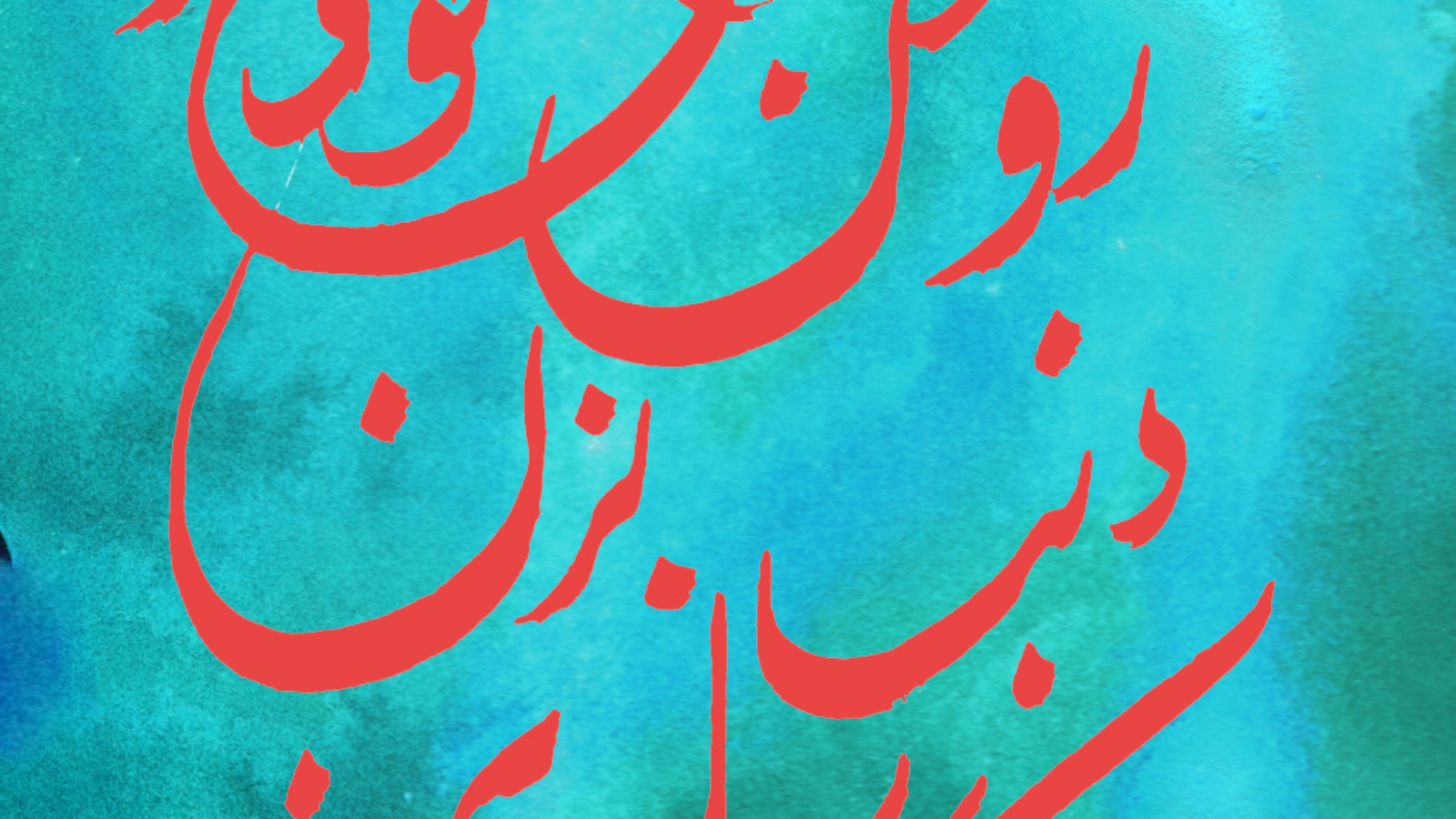
“If you want light, you must light a fire,” poetry by Mawlana Jalal ad-Din Muhammad Rumi, known by most simply as Rumi, the great poet who can be claimed by several modern nations, but who wrote in Persian (Farsi) in a manner that sounds as fresh, direct and poetic today as it must have when he first uttered the lines centuries ago. Original calligraphy by Stewart J. Thomas.
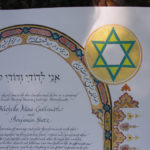
Detail of a marriage certificate featuring English, Persian (Farsi) and Hebrew calligraphy and a fine hand painted and illuminated border design. The Persian calligraphy features the poetry of Rumi. The Hebrew is the original text of “I am my beloved’s and my beloved is mine” from the Song of Solomon. For information on ordering marriage certificates visit palmstone.com.