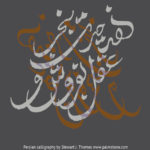
This line of poetry from Rumi has been translated as “Sell your cleverness and buy bewilderment.” I prefer “Sell your cleverness and buy be-wonderment.” The Persian says: buy the art of wonder. Calligraphy by Stewart J. Thomas, www.palmstone.com
This line of poetry from Rumi has been translated as “Sell your cleverness and buy bewilderment.” I prefer “Sell your cleverness and buy be-wonderment.” The Persian says: buy the art of wonder. Calligraphy by Stewart J. Thomas, www.palmstone.com
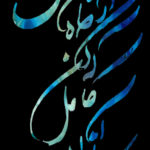
“Dance when you are perfectly free” Persian (Farsi) calligraphy by S.J. Thomas. No Ruz Pirooz!

Ayat al-Kursi (āyatu-l-kursī), the 255th verse (ayah) of the second chapter (sura) of the Qur’an, Al-Baqara. To listen to a recitation of this Ayat, along with translation into English, view here. For a description of the symmetry of the language in this verse read here.
آية الكرسي، وهي الآية رقم 255 من سورة البقرة في القرآن الكريم،.

Persian names in calligraphy by Stewart J. Thomas, calligrapher. www.palmstone.com
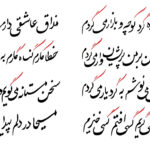
A poem of Mawlana Rumi, “Nah man beehodeh gerde koocheh.” If you would like to hear this song sung in the Sufi ecstatic style, here is a link to a rendering by Nusrat Fateh Ali Khan. The accent is definitely that of Pakistani Urdu, but the singing is all in the original Persian (Farsi), the language of all of Rumi’s poems.
The traslation/transliteration below is not mine, and includes the last two lines of the section, which are not included in the calligraphy version shown here.
Calligraphy by Stewart J. Thomas, www.palmstone.com
Naman behuda girde koocha o bazaar mi gardam,
Neither foolishly nor frivolously, in the lane and the market, I roam
Mazak-e-ashqui daram pa e didar mi gardam,
Possessed by the temperament of the lover I am, to have a glimpse, I roam
Khudaya reham kun bar mann pareeshaan waar mi gardam
O, God, the Almighty! Shower Your mercy upon me, disturbed and distracted, I roam
Khataa kaaram gunah gaaram bahaal e zaar mi gardam,
I am guilty, I am sinful and in this wretched condition, I roam
Sharaab-e-shouq mi nousham bagird e yaar mi gardam,
The wine of fondness I drink and round the Friend, I roam
Sukhan mastana mi goyam bhale hushyaar mi gardam,
Like the intoxicated I talk, but like the wise, I roam
Gahe khandam gahe giriyam gahe uftam gahe khezam,
Sometimes I laugh, sometimes I weep, sometimes I fall, sometimes I rise
Maseeha dar dilam paida ho mann beemaar mi gardam,
The Messiah is within my heart and like an invalid, I roam
Bayaan jaanan inayat kun to molana-e-rumi ra,
Come, O My Beloved! Come! Help your Maulana Rum
iGhulam-e-shams tabrezam qalandar war mi gardam
I am a slave of Shams Tabrizi and like a qalandar, I roam
(Translation from http://kalam-e-rumi.blogspot.com/)
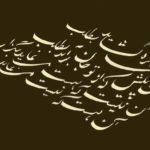
From Rumi:
Seek the science that unties for you this knot.
Seek it as long as there’s life in you still to be sought.
Leave that nothing that looks like it is something;
Seek that something that looks like nothing; it is not.
Translation by Zara Houshmand
Calligraphy by Stewart J. Thomas, palmstone.com

Wedding Monogram created by Stewart J. Thomas combines two names inside of a floral teardrop. www.palmstone.com
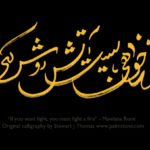
“if you want light, you must light a fire” Persian poetry by Jalaluddin Maulana Rumi. Persian (Farsi) calligraphy by Stewart J. Thomas www.palmstone.com.
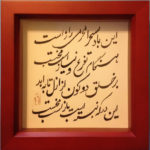
Poetry by Jalaluddin Rumi, calligraphy by Stewart J. Thomas, palmstone.com. A popular translation of this passage reads:
“The breezes at dawn have secrets to tell you.
Don’t go back to sleep!
You must ask for what you really want.
Don’t go back to sleep!
you really want.
People are going back and forth across the door sill where the two worlds touch.
The door is round and open.
Don’t go back to sleep!”


Earlier I posted the draft design for this commission. This is a photograph of the completed painting featuring the last lines of Khalil Gibran’s poem on marriage. Original calligraphic painting in Arabic by calligrapher Stewart J. Thomas.

“Heech” literally meaning “nothing” in Persian can also be understood as the void, the space to be filled by creation and creativity. This work is in homage to Parviz Tanavoli. His work, which II saw regularly growing up in Tehran has been an enormous inspiration in my own artwork and understanding of calligraphy.

The light within guides me and protects me. Original Arabic calligraphy by Stewart J. Thomas.

All who wander are not lost, Arabic calligraphy by Stewart J. Thomas

Persian (Farsi) calligraphy by Stewart J. Thomas, selection from the poem of Jalaludin Rumi, known in English as “Oh Soul, you worry too much”

Salaam Aleikum – Peace be with you. Original calligraphy design by Stewart J. Thomas.

3 lines of poetry from Mahmoud Darwish:
between two countries
never belonging in one
no longer belonging in the other
Calligraphy, ink and watercolour on mulberry paper by Stewart J. Thomas.

This rondel features original calligraphy and translation into Persian (Farsi) by Stewart J. Thomas of the Buddhist prayer:
May I be free from fear. May I be free from suffering.
May I be happy. May I be filled with loving kindness.
The first phrase begins at the position of about 1 if this were a clock.

“The sons of Adam are limbs of each other, Having been created of one essence.When the calamity of time affects one limbThe other limbs cannot remain at rest.If you have no sympathy for the troubles of others,You are unworthy to be called Human.”
Sa’adi Shirazi – Poet 13th Century
I found this piece of my own calligraphy posted on another blog. So, I thought I best reblog it here on my own Tumblr. This is the famous poem of Sa’adi that is engraved on the walls of the United Nations in New York. More of my work can be seen at palmstone.com … Stewart J. Thomas, calligrapher

Persian (Farsi) translation of “I am the fire that lives only in the rain.” Original Persian (Farsi) calligraphy by Stewart J. Thomas on marbled paper.

“Yeki bood, Yeki nabood” is the traditional beginning of Iranian stories: “Once there was, once there wasn’t … ” and so the tale begins. Persian (Farsi) calligraphy by Stewart Thomas.