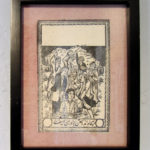
This is a print made from an old metal printing plate from Iran, I am guessing c. 1930s. The photo is of Joseph being thrown in the well by his brothers. The story is originally from the Torah, but also very popular in Persian poetry. The Farsi reads بچاه انداختن برادران يوسف را “into the well the brothers threw Joseph.” I reprinted this on translucent mulberry paper and layered it onto other papers to give the colour background. Framed print available at palmstone.com/for-syria/ to benefit Syrian refugee relief.
MAIMONIDES, MISHNEH TORAH, AUTOGRAPH DRAFT
Egypt, c. 1180, found in the Cairo Genizah.
This is a draft of a portion of the Book of Civil Laws, a section of the “Mishneh Torah” of Maimonides (1135– 1204), written in his own hand. The philosopher and royal physician wrote his masterpiece on rabbinic law in Hebrew, whereas his earlier works had been composed in Judeo-Arabic (Arabic in Hebrew characters). Maimonides’s cursive Sephardic script is similar to contemporary Arabic script. The pages seen here deal with the laws of hiring (right) and the laws of borrowed and deposited things (left).
Previous poster observed: I don’t detect any similarity between Maimonides’ Sephardic script and Arabic script, except that they’re both oriented right to left.
Stewart Thomas, calligrapher, says: This is a fascinating calligraphic hand, with clearly visible Hebrew characters combined with sections in a type of cursive. To me the cursive sections look very similar to contemporary Arabic script. Originally Hebrew and Arabic were both written with individually separated letters (and with short vowels unwritten). While Arabic evolved into its contemporary cursive form, Hebrew did not. This is a wonderful sampling of the beginnings of a Hebrew cursive form.

