Joseph and his brothers

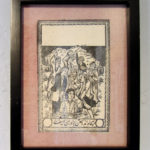
This is a print made from an old metal printing plate from Iran, I am guessing c. 1930s. The photo is of Joseph being thrown in the well by his brothers. The story is originally from the Torah, but also very popular in Persian poetry. The Farsi reads بچاه انداختن برادران يوسف را “into the well the brothers threw Joseph.” I reprinted this on translucent mulberry paper and layered it onto other papers to give the colour background. Framed print available at palmstone.com/for-syria/ to benefit Syrian refugee relief.

Libraries of Timbuktu

purplefigtree:

(Pages on astronomy from the Timbuktu Manuscripts).

Libraries of Timbuktu

“At the height of the city’s golden age, Timbuktu boasted not only the impressive libraries of Sankore and the other mosques, but also a wealth of private ones. One of the greatest, containing more than 700 volumes, was left by the master scholar Hajji Ahmad bin ‘Umar. His library was said to have included many of the rarest books ever written in Arabic, and he copied and annotated a considerable number of the volumes himself.

The libraries of Timbuktu grew through a regular process of hand-copying manuscripts. Scholars would visit the caravanserais and appeal to learned travelers to permit their precious volumes to be reproduced. Alternatively, they duplicated texts borrowed from their mentors’ collections, studying the material as they did so.

Al-Wazan commented that “hither are brought divers manuscripts or written books, which are sold for more money than any other merchandise.” As late as the close of the 19th century, Félix Dubois purchased a number of antique books in Timbuktu, including a copy of the Divan of Kings, a chronology of the rulers and events of the Sudan between 1656 and 1747.

Timbuktu’s position as a principal staging point along the pilgrimage route to Makkah may partly explain why so many books were available. Even so, modern scholars are staggered by the sheer quantity and rarity of Arabic texts and poems proffered and composed in the city. Of the books written in Timbuktu, a number are surprising in their scope. Ahmed Baba’s biographical dictionary, for example, included the lives of notables from Arabia, Egypt, Morocco and Central Asia, as well as Timbuktu itself.”

(From The Islamic Legacy of Timbuktu, Saudi Aramco World, Nov/Dec 1995)
MAIMONIDES, MISHNEH TORAH, AUTOGRAPH DRAFT

MAIMONIDES, MISHNEH TORAH, AUTOGRAPH DRAFT

Egypt, c. 1180, found in the Cairo Genizah.

This is a draft of a portion of the Book of Civil Laws, a section of the “Mishneh Torah” of Maimonides (1135– 1204), written in his own hand. The philosopher and royal physician wrote his masterpiece on rabbinic law in Hebrew, whereas his earlier works had been composed in Judeo-Arabic (Arabic in Hebrew characters). Maimonides’s cursive Sephardic script is similar to contemporary Arabic script. The pages seen here deal with the laws of hiring (right) and the laws of borrowed and deposited things (left).

Previous poster observed: I don’t detect any similarity between Maimonides’ Sephardic script and Arabic script, except that they’re both oriented right to left.
Stewart Thomas, calligrapher, says: This is a fascinating calligraphic hand, with clearly visible Hebrew characters combined with sections in a type of cursive. To me the cursive sections look very similar to contemporary Arabic script. Originally Hebrew and Arabic were both written with individually separated letters (and with short vowels unwritten). While Arabic evolved into its contemporary cursive form, Hebrew did not. This is a wonderful sampling of the beginnings of a Hebrew cursive form.