My first calligraphy instruction was in Persian (Farsi)* which uses the Arabic script. After the fifth grade we had to pass a major government exam in all subjects in order to complete elementary school and move on with our education. Among those subjects was calligraphy. We used the traditional qalam ney—a reed pen—which our teacher would cut for each of us. He would write a line of poetry at the top of the page in our notebooks and we would copy it over and over again down the rest of the page.
Qalam ney, or reed pens:

A reed pen is a simple affair. If you haven’t seen one, it is just like cutting a pen nib at the tip of a piece of thin bamboo. It is a dip pen. There is no reservoir to hold the ink. You just dip the pen into ink and write, run out of ink, repeat. In the hands of fifth graders this is a recipe for a mess: ink blots, splattered ink, spilled ink, you name it! Nevertheless the qalam ney is the absolutely best tool for creating the shapes required in Arabic calligraphy—more especially so for the particular style favoured by writers of Persian, a calligraphic style known as nasta’liq.
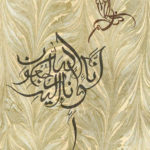
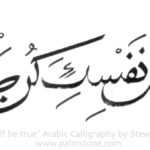
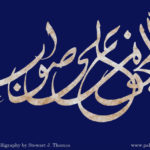
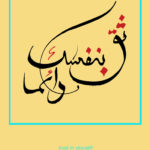
The nasta’liq calligraphy style (the examples shown are NOT my calligraphy!!! my work can be seen at the links given below):

The difference between myself and my classmates is that as soon as we passed our fifth class exam none of them ever touched a qalam again (not quite true: my best friend is now practicing calligraphy decades later—kudos to him!), while I ended up making calligraphy my profession. I must emphasize, I was not precociously talented in this endeavour, simply persistent. I love calligraphy! I’ve learned many scripts (and a few languages) and enjoy writing all of them. I’ve even made up a few scripts, some for my own amusement and a couple on commission; the latest for a fantasy novel.
Every script has its own aesthetic and tradition. At one end of the spectrum is a script like Amharic (from Ethiopia) that in practice allows for very little innovation. When I say “in practice” I mean that the audience for Amharic has little tolerance for going much beyond the bounds of using the script within the narrow confines of its traditional stylistic appearance.
At the other end of the spectrum is Arabic. Of all the calligraphic traditions, the Arabic script and its variants that are in use by some 60 languages in the word, has the widest scope for artistic expression. The traditional forms are challenging and I will most definitely be working for the rest of my life to write a good nasta’liq hand—the first calligraphic style I ever learned—and the other traditional forms. There are monumental styles of Arabic, such as thuluth, that reward precision and carefully measured composition. Persian artistic formats such as siamashq exemplify the art of improvisation in nasta’liq and shekasteh styles. Innovations and individual artistic expression in Arabic script are a vital part of the contemporary arts in many parts of the world, from West Africa to Paris to Western China.
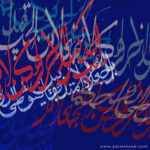
The shekasteh style:

My second favourite script is Chinese. You can see that I am a glutton for punishment. I will be working for the rest of my life on developing a passable grade in Chinese calligraphy as well! Chinese calligraphy runs the gamut as well, from formally constructed characters to loose, abstract brushwork. In cultures that use Chinese and related writing systems, as well as those that use Arabic script and its variants, calligraphy counts near the top of the scale in terms of art forms. In the hands of calligraphers in these traditions, calligraphy is like music in its variety of expression and in its emotional and aesthetic range. Imagine the scope of music from the blues to Beethoven, from a North Indian raga to an Andean pipe melody and you can get an idea of the range that calligraphy can cover within these two major world traditions.
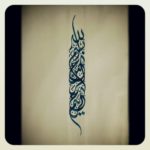
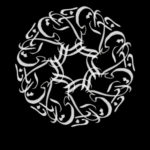
An example of a siamashq calligraphy composition:

My own work can be seen at these links:
Arabic, Persian, Farsi, Urdu and Dari Calligraphy
Calligrapher Stewart J. Thomas (@worldcalligraphy) • Instagram photos and videos
- Brief note on Persian vs. Farsi. The ancient Persian empire was an alliance between the Medes and the Persians. The Persians were and are a people from a southwestern province of Iran. The province is known as Pars and in Indo-european languages the sounds “P” and “F” are often interchangeable, so the province is also known as Fars. Someone or something from Pars or Fars is known as Parsi or Farsi. The ancient Greeks termed the empire to their east as the place of the Parsian — the plural of the people from Pars — which is a purely correct bit of “Persian” grammar. The common name for the language in English—from the Greek—is Persian. The common name for the language in Iran is Farsi—which is essentially the same word. Persian/Farsi is the official language of Iran, reflecting the dominant role that the Fars/Pars people still play in terms of literature and culture. There are between 8 and 16 other major languages spoken in Iran today depending on how you wish to define “major” (e.g., cultural importance vs. importance to identity vs. number of speakers).
 S. J. Thomas, Calligrapher